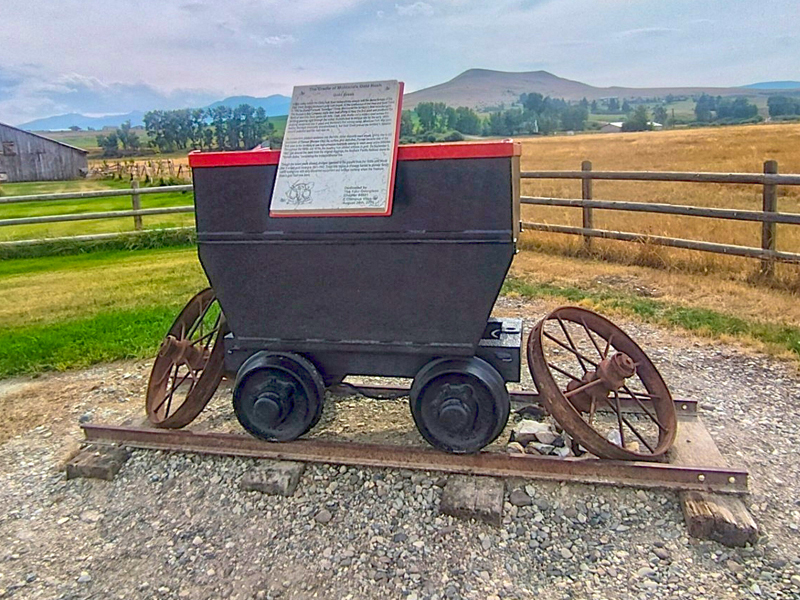
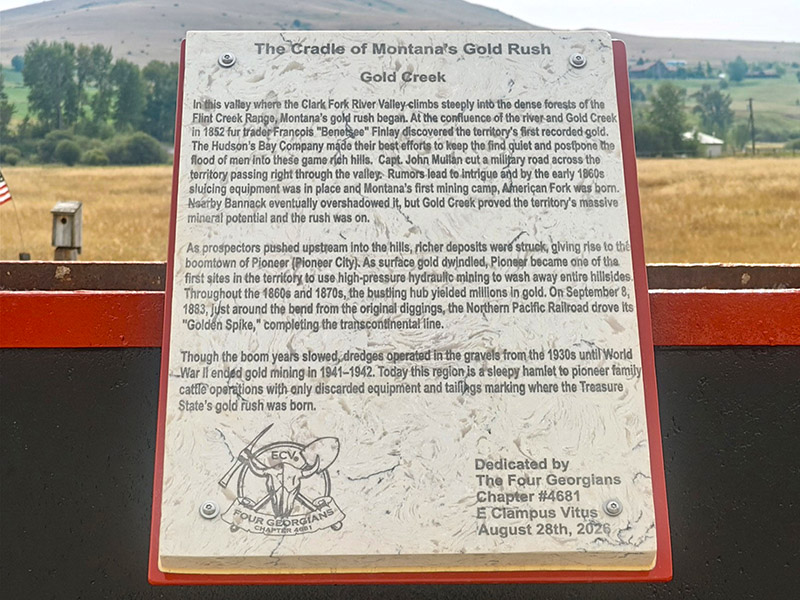
The Cradle of Montana's Gold Rush
Gold Creek
In this valley where the Clark Fork River Valley climbs steeply into the dense forests of the Flint Creek Range, Montana’s gold rush began. At the confluence of the river and
Gold Creek in 1852, fur trader Francois “Benne” Finlay discovered the territory’s first recorded gold. The Hudson’s Bay Company made their best efforts to keep the find quiet
and postpone the flood of men into these game-rich hills. Capt. John Mullan cut a military road across the territory passing right through the valley. Rumors lead to intrigue
and by the early 1860s sluicing equipment was in place and Montana’s first mining camp, American Fork, was born. Nearby Bannack eventually overshadowed it, but Gold Creek
proved the territory’s massive mineral potential and the rush was on.
As prospectors pushed upstream into the hills, richer deposits were struck, giving rise to the boomtown of Pioneer (Pioneer City). As surface gold dwindled, Pioneer became one
of the first sites in the territory to use high-pressure hydraulic mining to wash away entire hillsides. Throughout the 1860s and 1870s, the bustling hub yielded millions in
gold. On September 8, 1883, just around the bend from the original diggings, the Northern Pacific Railroad drove its “Golden Spike,” completing the transcontinental line.
Though the boom years slowed, dredges operated in the gravels from the 1930s until World War II ended gold mining in 1941–1942. Today this region is a sleepy hamlet to pioneer
family cattle operations with only discarded equipment and tailings marking where the Treasure State’s gold rush was born.
Dedicated by
The Four Georgians
Chapter #4681
E Clampus Vitus
August 28th, 2026